
Why Every Man Needs a Structured Training Plan
Most men who struggle to see results in the gym share one common problem — they train without a plan. Walking into the gym with no direction leads to wasted time, uneven muscle development, and frustrating plateaus. Following a structured Best Workout Schedule is the single most impactful shift you can make to start building real, visible results week after week.
A well-designed schedule acts as your roadmap. It tells you exactly which muscle groups to train, how hard to push, and when to rest. Without this structure, your body never receives the consistent stimulus it needs to adapt and grow stronger. Think of it this way: your muscles respond to progressive overload and regular recovery, not random effort.
Understanding Training Frequency and Recovery
One of the most overlooked elements of fitness is knowing how often to train each muscle group. Research consistently shows that training a muscle group at least twice per week maximizes hypertrophy, which is the technical term for muscle growth. However, training frequency must be balanced with adequate recovery time — rest is where the actual growth happens.
Beginners typically thrive on 3–4 training days per week, giving their bodies ample time to recover between sessions. Intermediate lifters can handle 4–5 days, while advanced athletes may push 5–6 days with strategically placed rest days. Regardless of your level, skipping rest days is one of the fastest routes to injury, burnout, and stalled progress.
Sleep also plays a crucial role. During deep sleep, the body releases growth hormone, repairs muscle tissue, and consolidates the neuromuscular patterns built during training. Aim for 7–9 hours of quality sleep per night alongside your training program to unlock your full potential.
Best Workout Schedule for Beginners: Build the Foundation
If you are new to the gym, your primary focus should be mastering form and building a base level of strength across all major muscle groups. Full-body workouts three days per week are ideal because they keep sessions manageable while ensuring every muscle is stimulated regularly.
Sample 3-Day Beginner Weekly Plan:
- Monday: Bodyweight Squats, Push-Ups, Plank Holds, Dumbbell Rows
- Wednesday: Goblet Squats, Shoulder Press, Bicycle Crunches, Walking Lunges
- Friday: Deadlifts (light), Incline Push-Ups, Mountain Climbers, Lat Pulldowns
Keep rep ranges between 10–15 per set and focus on controlled, deliberate movement rather than heavy weight. Progressive overload — gradually increasing reps, sets, or resistance over time — is the engine behind all long-term progress. After 8–12 weeks of consistent training, you will be ready to move to an intermediate program.
Intermediate Training: Compound Lifts and Split Programming
At the intermediate stage, full-body workouts give way to split training, where you dedicate different days to different muscle groups. This allows you to increase training volume per muscle group, which is essential for continued growth. A 4-day upper/lower split or a push/pull/legs (PPL) structure works exceptionally well here.
Sample 4-Day Upper/Lower Split:
- Monday: Upper Body — Bench Press, Barbell Rows, Overhead Press, Pull-Ups
- Tuesday: Lower Body — Squats, Romanian Deadlifts, Lunges, Calf Raises
- Thursday: Upper Body — Incline Dumbbell Press, Seated Cable Rows, Lateral Raises, Bicep Curls
- Friday: Lower Body — Deadlifts, Leg Press, Hamstring Curls, Glute Bridges
Aim for 3–4 sets per exercise with rep ranges between 8–12 for hypertrophy. Rest 60–90 seconds between sets to maintain metabolic stress while keeping intensity high. At this level, tracking your lifts becomes essential — use a notebook or an app to log weights, sets, and reps every session.
Advanced Training: High Volume and Specialization
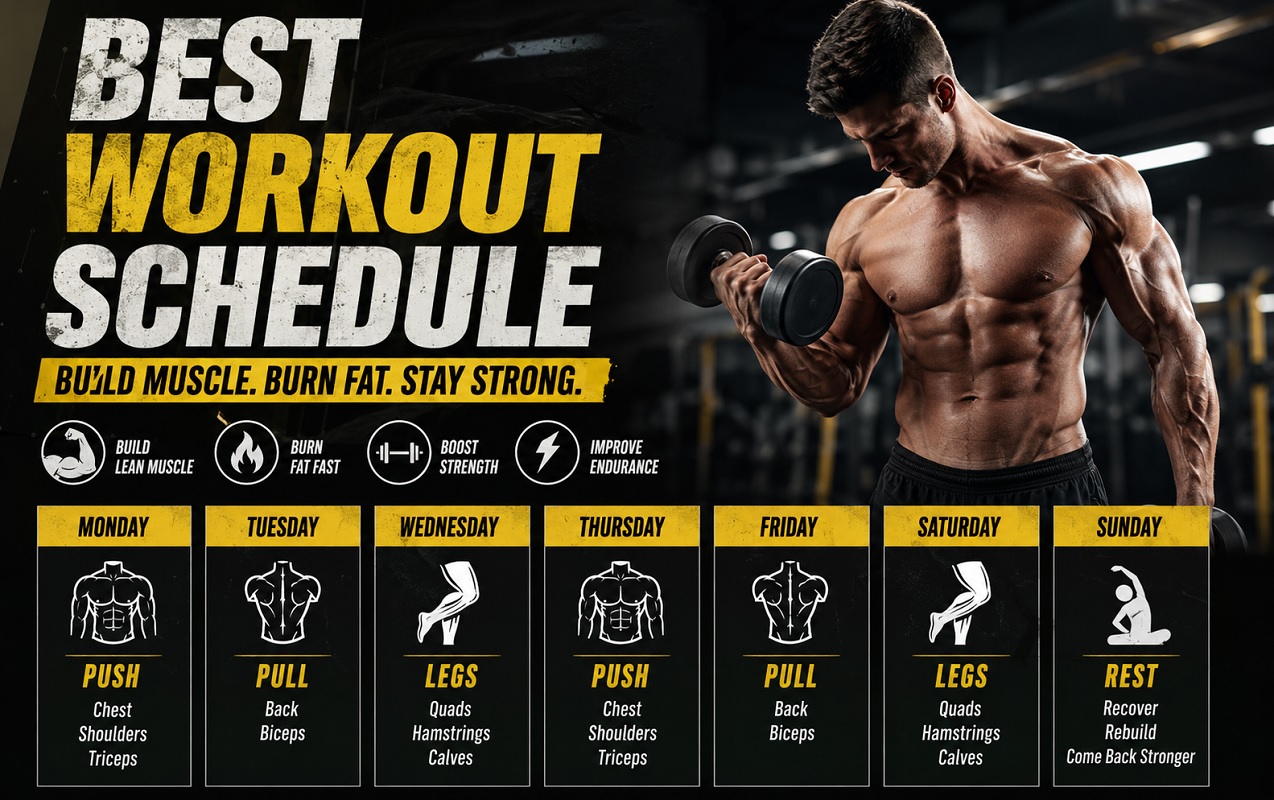
For experienced lifters who have built a strong base, advanced programming introduces higher weekly volume, specialized techniques, and refined periodization strategies. A 5–6 day Push/Pull/Legs split is one of the most effective structures at this level, ensuring each muscle group is trained twice per week with targeted focus.
Sample 6-Day PPL Split:
- Monday: Push — Bench Press, Incline Dumbbell Press, Overhead Press, Tricep Dips, Lateral Raises
- Tuesday: Pull — Deadlifts, Barbell Rows, Lat Pulldown, Bicep Curls, Hammer Curls
- Wednesday: Legs — Squats, Romanian Deadlifts, Leg Press, Leg Curls, Calf Raises
- Thursday: Push (Repeat with variation)
- Friday: Pull (Repeat with variation)
- Saturday: Legs (Repeat with variation)
- Sunday: Rest
Advanced techniques like drop sets, rest-pause sets, and supersets can be incorporated to intensify sessions. However, these tools should be used sparingly — on the final sets of key exercises — to avoid excessive fatigue accumulation across the week.
The Role of Cardio in Your Weekly Plan
Strength training builds the physique, but cardio plays an irreplaceable role in cardiovascular health, fat loss, and overall endurance. The key is integrating cardio without it interfering with muscle recovery and growth. Low-intensity steady-state (LISS) cardio, such as brisk walking or cycling, is the safest choice on rest days or after weight training sessions.
High-intensity interval training (HIIT) is more time-efficient for fat loss and can be performed 2–3 times per week, ideally on dedicated cardio days. A typical HIIT session involves sprinting for 30–40 seconds followed by 60 seconds of active recovery, repeated for 20–30 minutes. This style of cardio preserves muscle mass far better than long-duration steady-state runs.
For men focused primarily on muscle building, limit cardio to 2–3 sessions per week and keep sessions under 30 minutes. For those with fat loss as the primary goal, 3–5 cardio sessions per week combined with a caloric deficit will produce the most dramatic body composition changes.
Nutrition: The Fuel Behind Every Workout
No matter how well-designed your training program is, poor nutrition will sabotage your results. Your body needs adequate protein to repair and build muscle tissue — aim for 0.7 to 1 gram of protein per pound of bodyweight daily. High-quality sources include chicken breast, eggs, lean beef, Greek yogurt, and whey protein supplements.
Carbohydrates are your primary training fuel. Consuming complex carbohydrates — such as oats, brown rice, sweet potatoes, and whole grains — before workouts ensures you have the energy to train hard and lift heavy. Post-workout nutrition is equally important; a combination of fast-digesting protein and carbohydrates within 30–60 minutes of training accelerates muscle recovery and glycogen replenishment.
Healthy fats from avocados, nuts, seeds, and olive oil support testosterone production, joint health, and hormone regulation. Men who drastically reduce dietary fat often notice drops in energy, mood, and training performance. A balanced macronutrient approach — roughly 40% carbs, 30% protein, and 30% fats — provides a solid nutritional foundation for most training goals.
How to Choose the Best Workout Schedule for Your Lifestyle
Consistency always beats perfection. The best workout schedule for you is one that fits your real life — your work schedule, family commitments, and recovery capacity. A 3-day program performed consistently for 6 months will always outperform a 6-day program abandoned after 3 weeks.
Start by honestly assessing how many days per week you can realistically commit to training. If you can only dedicate 3 days, choose a full-body or push/pull/legs 3-day split. If you have 5 days available, an upper/lower or PPL structure will serve you well. The most important factor is building a habit that becomes non-negotiable in your weekly routine.
Progress tracking is a critical component of staying consistent and motivated. Celebrate small wins — an extra rep, a heavier weight, a tighter waistline. These incremental improvements compound into extraordinary long-term transformations when you stay committed to your program.
Common Mistakes That Derail Progress
Even with a great program, certain habits can silently undermine your results. Here are the most common training mistakes men make and how to avoid them:
- Skipping warm-ups: 5–10 minutes of dynamic stretching and light cardio reduces injury risk and improves performance
- Neglecting progressive overload: If you’re lifting the same weights with the same reps for months, your body has no reason to change
- Ignoring weak points: Most men over-train chest and biceps while neglecting back, legs, and core — imbalances that lead to injury
- Training through pain: Soreness is normal; sharp or joint pain is a signal to stop and assess
- Inconsistent sleep and hydration: Even one poor night of sleep or mild dehydration measurably reduces strength output and focus
Avoiding these pitfalls is just as important as executing a quality program. The men who achieve remarkable physiques are not necessarily those with the most complex programs — they are the ones who master the fundamentals and execute them consistently without excuses.
Stay the Course and Trust the Process
Long-term fitness success is built on daily decisions, not dramatic overnight transformations. Sticking to a proven Best Workout Schedule week after week, fueling your body with quality nutrition, prioritizing sleep, and managing stress creates a compounding effect that reshapes your physique and performance over months and years.
Every elite athlete, whether competitive bodybuilder or professional sportsman, follows a structured training system. They don’t leave their progress to chance. You shouldn’t either. Set clear goals, pick a schedule that matches your fitness level and lifestyle, and commit to the process with patience and discipline. The results you want are on the other side of consistent, intelligent effort — and they are absolutely within your reach.